

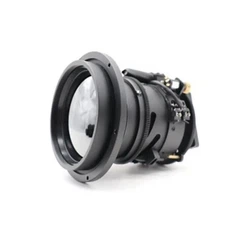

In the realm of infrared imaging, manual focusing long - wave infrared (LWIR) lenses play a crucial role, offering distinct advantages in various applications such as surveillance, anti - drone systems, and handheld night vision devices. One of the key optical aberrations that significantly impacts the performance of these lenses is the Petzval field curvature. As a leading supplier of manual focusing LWIR lenses, understanding and addressing the Petzval field curvature is essential for delivering high - quality products.
Understanding the Basics of Petzval Field Curvature
Petzval field curvature is an optical aberration that causes the image of a flat object to be formed on a curved surface rather than a flat plane. This phenomenon was first described by József Petzval in the 19th century. In a well - corrected lens, the image of a flat object should be projected onto a flat image sensor. However, due to the nature of the lens design and the way light rays are refracted through different lens elements, the Petzval field curvature can occur.
Mathematically, the Petzval sum (P) is a measure related to the field curvature. It is given by the formula (P=\sum_{i = 1}^{n}\frac{n_{i}-1}{n_{i}r_{i}}), where (n_{i}) is the refractive index of the (i) - th lens element and (r_{i}) is the radius of curvature of the (i) - th surface. A non - zero Petzval sum indicates the presence of field curvature.
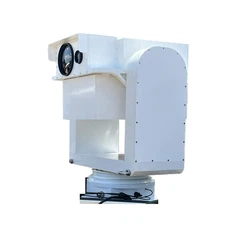
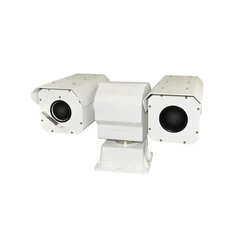
When it comes to manual focusing LWIR lenses, the Petzval field curvature can have a significant impact on the image quality. In LWIR applications, where the detection of thermal signatures is crucial, a curved image plane can lead to parts of the image being out of focus. For example, in a surveillance scenario using an Ultra - long Range Dual Camera PTZ with Tracking and Stabilization, if the lens has a large Petzval field curvature, the edges of the field of view may appear blurry while the center is in focus. This can make it difficult to accurately detect and identify objects, especially in long - range surveillance where every detail matters.
Causes of Petzval Field Curvature in Manual Focusing LWIR Lenses
Several factors contribute to the Petzval field curvature in manual focusing LWIR lenses. One of the primary factors is the choice of lens materials. LWIR lenses often use materials such as germanium, silicon, and chalcogenide glasses. These materials have different refractive indices and dispersion properties, which can affect the way light is refracted and focused. For instance, germanium has a relatively high refractive index, which can contribute to a larger Petzval sum if not properly compensated in the lens design.
The lens design itself also plays a crucial role. The number of lens elements, their shapes, and the spacing between them all influence the Petzval field curvature. In manual focusing LWIR lenses, the design may be optimized for a certain focal length and field of view. However, achieving a flat image plane while maintaining other optical properties such as high resolution and low distortion can be a challenging task. For example, adding more lens elements can help correct the field curvature, but it also increases the complexity of the lens design, the cost of production, and the weight of the lens.
Effects of Petzval Field Curvature on Different Applications
Surveillance
In surveillance applications, the presence of Petzval field curvature can degrade the image quality significantly. As mentioned earlier, in long - range surveillance systems, a curved image plane can result in a loss of detail at the edges of the field of view. This can be a major problem when trying to detect and track moving objects, such as vehicles or people. In addition, in multi - camera surveillance setups, inconsistent focus across the field of view due to field curvature can make it difficult to stitch together images from different cameras to create a seamless panoramic view.
Anti - drone Systems
In Anti - drone RF Sensors, the ability to accurately detect and track drones is crucial. A manual focusing LWIR lens with a large Petzval field curvature can make it challenging to obtain a clear image of the drone, especially if it is flying near the edges of the field of view. This can lead to false alarms or missed detections, which can have serious consequences in security - critical applications.


Handheld Night Vision Devices
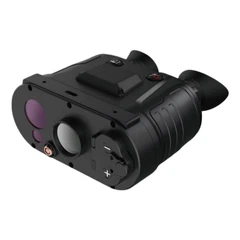
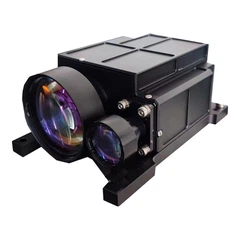
For Handheld Night Vision Binocular With Laser Rangefinder, the user expects a clear and sharp image across the entire field of view. Petzval field curvature can cause the edges of the image to be out of focus, reducing the overall usability of the device. In addition, in low - light conditions where every bit of detail is important, a blurry image due to field curvature can make it difficult to identify objects accurately.
Mitigating Petzval Field Curvature in Manual Focusing LWIR Lenses
As a supplier of manual focusing LWIR lenses, we employ several strategies to mitigate the Petzval field curvature. One of the most common methods is to use a combination of positive and negative lens elements. By carefully selecting the refractive indices and radii of curvature of these elements, we can balance the Petzval sum and reduce the field curvature. For example, a negative lens element can be used to counteract the positive contribution to the Petzval sum from a positive lens element.
Another approach is to use aspherical lens surfaces. Aspherical lenses have a non - spherical shape, which allows for more precise control of the way light rays are refracted. By using aspherical surfaces in the lens design, we can correct the field curvature more effectively compared to traditional spherical lenses. However, manufacturing aspherical lenses is more complex and expensive, so it is often used in high - end lens designs where image quality is of the utmost importance.
We also conduct extensive optical simulations during the lens design process. These simulations allow us to predict the Petzval field curvature and other optical aberrations before the lens is actually manufactured. By adjusting the lens parameters in the simulation, we can optimize the design to minimize the field curvature while meeting other performance requirements such as resolution, distortion, and transmission.
Importance of Petzval Field Curvature Control for Our Customers
For our customers, having a manual focusing LWIR lens with minimal Petzval field curvature is essential for achieving high - quality imaging results. In surveillance applications, it means being able to detect and identify objects accurately, even at the edges of the field of view. In anti - drone systems, it ensures reliable detection and tracking of drones, reducing the risk of false alarms and missed detections. In handheld night vision devices, it provides a clear and sharp image, enhancing the user experience.
By controlling the Petzval field curvature, we can also improve the overall performance and reliability of our lenses. Lenses with less field curvature are less likely to suffer from focus inconsistencies, which can lead to more stable and accurate imaging over time. This is particularly important in applications where the lens needs to operate in harsh environments or for extended periods.
Conclusion
In conclusion, the Petzval field curvature is a significant optical aberration that affects the performance of manual focusing LWIR lenses. As a supplier, we understand the importance of addressing this issue to provide our customers with high - quality lenses that meet their specific needs. Through careful lens design, the use of appropriate materials, and advanced manufacturing techniques, we are able to mitigate the Petzval field curvature and deliver lenses that offer excellent image quality across the entire field of view.
If you are interested in learning more about our manual focusing LWIR lenses or have specific requirements for your application, we encourage you to contact us for a detailed discussion. Our team of experts is ready to assist you in finding the best lens solution for your needs.
References
- Smith, W. J. (2008). Modern Optical Engineering: The Design of Optical Systems. McGraw - Hill.
- Hecht, E. (2017). Optics. Addison - Wesley.
- Born, M., & Wolf, E. (1999). Principles of Optics: Electromagnetic Theory of Propagation, Interference and Diffraction of Light. Cambridge University Press.