

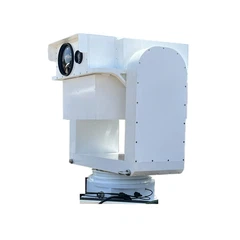
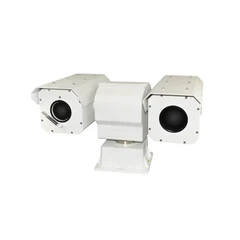
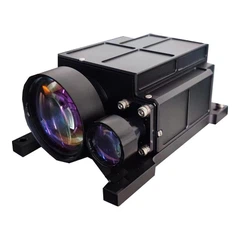
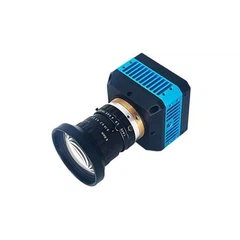


GL10 Series Online Gas Cloud Imaging Camera
Fixed-Mount PTZ Infrared Imaging for Continuous Gas Leak Detection & Localization
400+ VOC gas types detected
3 km max viewing...
Gas Leakage Detection
Gas Leakage Detection
Thermal imaging and quantum LiDAR gas leakage detection systems identify, visualise and — where continuous, quantified data is required — measure gas leaks in real time. Crucial tools for safety, compliance and maintenance across industrial operations.
CONTINUOUS MONITORING VS. PORTABLE INSPECTION
Gas leak detection covers two very different jobs. The first is fast, operator-led inspection — walking a site with a thermal camera to visualise a plume and flag it for repair. The second is continuous, unattended, quantified monitoring — the permanent record regulators and ESG auditors now expect. IREO CAM&SYS supplies both.
QUANTUM GAS LIDAR — CONTINUOUS AUTONOMOUS MONITORING
Most gas detection technology tells you that a leak exists. Quantum Gas LiDAR tells you how much is leaking, precisely where it is coming from, and logs that data automatically every 30 seconds — around the clock, without a crew, in any weather. A single-photon laser scans up to 500 metres in every direction; an integrated anemometer converts the readings into a calibrated emission rate, feeding directly into your compliance reporting rather than producing an image for manual interpretation.
<10 g/hr
Min. detectable leak
500 m
Detection range
30 s
Response time
24/7/365
Autonomous operation
How photon quantum LiDAR works
The system fuses three proven measurement techniques into one sensor: tunable diode laser absorption spectroscopy (TDLAS), differential absorption LiDAR (DIAL), and time-correlated single-photon counting (TCSPC). An eye-safe infrared laser is continuously tuned across the methane absorption line and amplitude-modulated with a randomised code, then swept across a circular field of view by a pair of rotating Risley prisms — passing through any gas plume in its path before reflecting off the tanks, pipework or structures beyond it.
The returning light is captured by a single-photon avalanche detector — in effect a “photon Geiger counter” sensitive enough to count individual photons scattered back from up to 500 metres away. Each pulse yields two measurements: time of flight, which fixes the distance to the reflecting surface, and the absorption signature, which gives the gas concentration path length (in ppm·m) along that exact line of sight. Repeated across the full scan, this builds a live 3D map of the scene and the gas cloud in front of it — location, shape and size — rather than a modelled estimate.
Combined with wind speed and direction from the integrated anemometer, that 3D gas map becomes a volumetric emission rate: a defensible number, not just a picture.
- Scan — an eye-safe laser sweeps the site on a 360°×180° PTZ mount, passing through any gas plume in its path.
- Detect — a single-photon detector counts individual returning photons to sense gas at concentrations invisible to thermal imaging.
- Locate — time-of-flight measurement pinpoints the exact distance and position of the leak source, down to the component level.
- Quantify — concentration path-length and wind data combine into a real emission rate, logged automatically for compliance reporting.
Independently verified: approved by the US EPA as an Alternative Test Method for methane detection under the OOOO regulation programme, and ranked first for quantification accuracy, source-localisation accuracy, detection time and detection limit in an 11-week, all-weather blind test against ten competing technologies at Colorado State University’s Methane Emissions Technology Evaluation Center (METEC).
Ideal for permanent site-wide monitoring, LDAR automation and EPA/EU emissions compliance. Full technical specifications and cloud platform details: Quantum Gas LiDAR product & specification page.
THERMAL OGI CAMERAS — HANDHELD, ONLINE & AIRBORNE
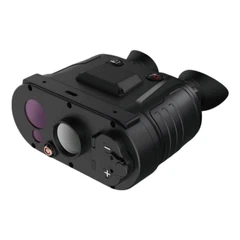
Engineered using Mid-Wave Infrared (MWIR, cooled) and Uncooled Long-Wave Infrared (LWIR) technologies, our thermal OGI systems deliver real-time visualisation of gas plumes with pseudo-colour labelling and semi-quantitative concentration analysis — non-contact, with no auxiliary light source required. Built for the petrochemical, chemical and environmental sectors, these systems minimise risk, improve operational efficiency and support regulatory compliance.
Available in three deployment forms — Handheld, Online (fixed-mount) and Airborne — this page covers our Handheld range in detail.
- Online Gas Leakage Detection
- Airborne Gas Leakage Detection
Key advantages
- High sensitivity — cooled MWIR detectors achieve NETD of 15 mK; uncooled models offer a cost-effective alternative.
- Gas visualisation — real-time imaging shows exact leak location and extent, what-you-see-is-what-you-get.
- Efficiency — rapid scanning eliminates carpet-style searching and enables wide-area coverage.
- Safety — non-contact passive imaging from a safe distance; explosion-proof certified variants available.
- Customisation — spectral ranges tailored to application, supporting detection of 400+ VOCs, CO, CO₂, SF₆, NH₃ and more.
- Integration — compatible with the Infrared-See platform for intelligent monitoring, alarms and data analysis.
- Durability — IP68-rated, up to 30,000-hour MTBF (cooled models), built for extreme conditions.
Detectable gases by spectral band
|
Spectral Band |
Detectable Gases |
|
MWIR 3.2–3.44 µm |
Methane, ethane, propane, butane, pentane, ethylene, benzene, toluene, xylene, methanol, ethanol, isopropanol, MEK, MIBK, acetic acid, CO, CO₂, SF₆, NH₃ and ~400 VOCs in total |
|
LWIR 7–8.5 µm |
CH₄, N₂O, propane, phenol, SO₂, R-134a and R-152a refrigerants |
|
LWIR 9.5–12 µm |
SF₆, NH₃, ethylene, propylene, vinyl chloride |
Full compound-level gas lists available on request or on the detailed product specification page.
Application scenarios
- Natural gas pipeline and oil refinery inspection
- Industrial plant safety checks
- HVAC system maintenance
- Environmental monitoring
- First-responder safety in hazardous situations
View the full handheld camera range and specifications: Handheld Gas Leakage Detection.
WHICH SOLUTION FITS YOUR SITE?
Many operators use both: OGI cameras for initial survey and routine inspection, Quantum Gas LiDAR for the continuous, quantified compliance record regulators and ESG auditors now expect. Talk to us and we'll help you match the right technology, or combination, to your site profile, jurisdiction and budget.
Talk to us
Request a technical brief, indicative pricing, a live product demonstration, or application engineering support for your site.
Send an enquiry →
-
![Online Gas Cloud Imaging Camera]()
-
![Airborne Gas Leak Detector]() Airborne Gas Leak DetectorGL10AE Airborne Gas Leak Detectorread more
UAV-Mounted Infrared Gas Imaging Payload for Aerial Pipeline & Facility Inspection
320×256 cooled IR resolution
≤15 mK NETD @25°C
1.6 kg... -
![Single-Photon Quantum Gas LiDAR]() Single-Photon Quantum Gas LiDARGL-Q500 Photon Quantum Gas LiDARread more
Single-Photon Quantum LiDAR for Continuous, Autonomous Methane Detection, Localization & Quantification
500 m max detection distance
360°×180° ... -
![Handheld Gas Leakage Detection]() Handheld Gas Leakage DetectionCompact and explosion-proof, this handheld gas leak detector is designed for mobile inspection in industrial environments. Equipped with high-sensitivity cooled/uncooled IR detectors, it...read more


IR-EO Cameras & Systems Co., Ltd. is one of the most professional gas leakage detection manufacturers and suppliers in China, specialized in providing high quality customized service. We warmly welcome you to buy high-grade gas leakage detection made in China here from our factory.