

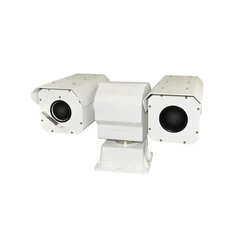
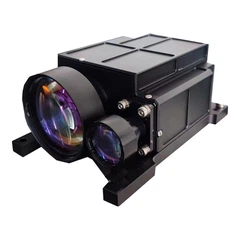
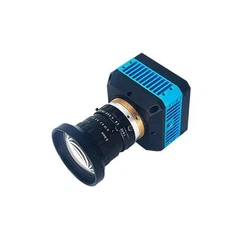

Laser Illuminator
Laser Illuminators: From Basic Principles to Advanced Integration in EO/IR ISRT Systems
Laser illuminators (or abrev. LI) are specialized devices that emit coherent light to enhance visibility in low-light or obscured environments. Unlike traditional light sources such as LEDs or halogen lamps, laser illuminators produce a narrow, focused beam of monochromatic light, offering superior range, intensity, and control. This technology has evolved from simple consumer applications to sophisticated military systems, where it integrates seamlessly with Electro-Optical/Infrared Intelligence, Surveillance, Reconnaissance, and Targeting (ISRT) platforms.
We here introduce the fundamentals of laser illuminators and their integration with EO/IR ISRT systems, progressing from ordinary civilian uses to advanced military implementations, including gating technology.
Basic Introduction to Laser Illuminators
At their core, laser illuminators operate on the principle of stimulated emission, where photons stimulate excited atoms in a gain medium (such as a semiconductor or gas) to emit light of a specific wavelength. Common wavelengths include infrared (IR, 700-1550 nm) for covert operations, as they are invisible to the human eye but detectable by night vision devices.
The key advantages of laser illuminators over conventional lights are:
- high collimation (minimal beam divergence),
- monochromaticity (single color for better contrast), and
- efficiency (low power consumption for high output).
In ordinary applications, laser illuminators are used in security cameras, automotive night vision, and wildlife observation. For instance, a basic NIR laser illuminator paired with a CCTV camera can extend effective surveillance range to 100-200 meters in complete darkness. These systems typically employ continuous wave (CW) lasers with power outputs of 1-5 watts, ensuring eye safety through Class 1 or 1M ratings under IEC 60825 standards.
The integration is straightforward: the illuminator mounts coaxially with the camera, synchronizing with its field of view (FOV) to flood the scene with invisible light, which is then captured by IR-sensitive sensors.
Integration with EO/IR ISRT Systems
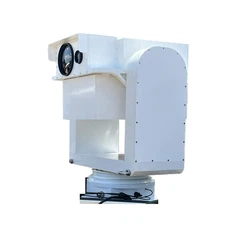
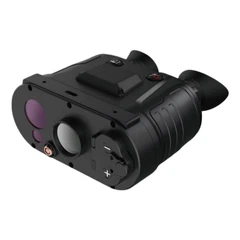
EO/IR ISRT systems combine visible light (EO) cameras, infrared (IR) sensors, and targeting tools for comprehensive situational awareness. Laser illuminators enhance these systems by active illumination, compensating for passive IR limitations in low-contrast or shadowed scenes. Integration involves aligning the laser beam with the sensor's optical axis, often using beam expanders or diffusers to match the FOV.
In civilian ISRT setups, such as border patrol or industrial monitoring, laser illuminators improve image quality without external light sources. For example, a 850 nm laser can boost EO camera performance in fog or smoke, where IR might struggle with thermal noise. The setup typically includes a power supply, control electronics for pulse modulation, and software for automatic intensity adjustment based on ambient light.
Moving to military-grade integration, laser illuminators become integral to advanced ISRT platforms like unmanned aerial vehicles (UAVs) or ground-based turrets. Here, they enable "active imaging," where the laser pulses synchronize with sensor gates to reduce backscattering from atmospheric particles. This is particularly useful in degraded visual environments (DVE), such as dust storms or heavy rain.
From Ordinary to Military Applications: The Role of Gating Technology
Ordinary laser illuminators operate in CW mode, providing constant illumination for short-range tasks. In consumer drones or home security, they extend night vision to 50-100 meters, with simple on/off controls.
At the tactical military level, pulsed lasers are employed for longer ranges (up to 5 km, or even to longer range). Integration with EO/IR ISRT involves solid-state lasers (e.g., diode-pumped Nd:YAG at 1064 nm, Erbium doped glass at 1530-1550nm) for target designation and illumination. For instance, in vehicle-mounted systems, the illuminator aids in identifying threats during nighttime patrols, with beam shaping to cover wide areas.
Advanced military applications introduce Gating technology, a time-synchronized method that elevates performance. Gated laser illuminators pulse light in short bursts (nanoseconds), and the sensor "gates" open only during the return echo, filtering out unwanted reflections from fog, rain, or smoke. This is based on time-of-flight principles, similar to LIDAR but optimized for imaging.
In high-end ISRT systems, like those on fighter jets or UAVs, gated illuminators use range-gating to achieve "see-through" capability. For example, a 1550 nm eye-safe laser with 10 ns pulses can illuminate targets at 1-2 km while ignoring foreground clutter, improving contrast by 50-100% in adverse weather. Military variants often incorporate adaptive optics and AI for dynamic gating, adjusting pulse width based on distance and conditions. In some tropical or sub-tropica rainy climate, where showers occur almost daily, gated systems maintain 1-1.5 km human tracking. even recognition reliability, as seen in customized specialized EO/IR system.
Gating also enables "burst illumination" for covert operations, minimizing detection risk. In ISRT integration, the laser synchronizes with IR focal plane arrays (FPAs), using technologies like intensified CCD (ICCD) or short-wave IR (SWIR) sensors for sub-microsecond gating, achieving resolutions down to centimeters.
Challenges and Future Trends
While laser illuminators enhance ISRT, challenges include eye safety regulations (limiting power) and thermal management in compact designs. Military systems mitigate this with Class 1M lasers and beam divergence controls.
Future trends point to multi-spectral illuminators combining NIR and SWIR for broader environmental adaptability, integrated with AI for autonomous targeting. As conflicts intensify, gated laser-EO/IR hybrids will become standard in defense, offering unparalleled clarity in contested spaces.
In summary, laser illuminators transform EO/IR ISRT from passive observers to active enablers, evolving from basic night vision aids to gated military powerhouses. Their integration drives precision in surveillance, ensuring operational superiority across civilian and defense domains.
Our products (To Be Released Soon)
IR-EO Cameras & Systems Co., Ltd. is one of the most professional laser illuminator manufacturers and suppliers in China, specialized in providing high quality customized service. We warmly welcome you to buy high-grade laser illuminator made in China here from our factory.