









Introduction
The mining industry, particularly coal mining, has always been a challenging environment due to its inherent risks, including gas leaks, fires, structural instability, and poor visibility. To mitigate these risks and enhance operational efficiency, advanced technologies such as thermal imagers and wide-spectrum cameras have become indispensable tools. These devices provide critical insights into the mining environment, enabling safer and more efficient operations. This article explores the applications, advantages, and limitations of thermal imagers and wide-spectrum cameras in coal mining.
1. Thermal Imagers in Coal Mining
Thermal imagers detect infrared radiation emitted by objects and convert it into a visible image, allowing users to visualize temperature differences. In coal mining, thermal imaging technology is used for a variety of applications.
1.1 Applications of Thermal Imagers
1.1.1 Fire Detection and Prevention
Coal mines are highly susceptible to fires due to the presence of combustible materials like coal dust and methane gas. Thermal imagers can detect hotspots and temperature anomalies long before they become visible to the naked eye. This early detection allows for timely intervention, preventing catastrophic fires.
1.1.2 Equipment Monitoring
Mining equipment, such as conveyor belts, motors, and electrical systems, often operates under high stress and can overheat. Thermal imagers are used to monitor the temperature of these components, identifying potential failures before they occur. This reduces downtime and maintenance costs.
1.1.3 Gas Leak Detection
Methane gas leaks are a significant hazard in coal mines. Thermal imagers can detect gas leaks by visualizing the temperature differences caused by the escaping gas. This helps in locating leaks quickly and implementing corrective measures.
1.1.4 Structural Integrity Assessment
Thermal imaging can be used to assess the structural integrity of mine walls and roofs. Temperature variations can indicate areas of stress or weakness, helping engineers identify potential collapse risks.
1.2 Pros and Cons of Thermal Imagers
Pros:
- Non-Contact Measurement: Thermal imagers can measure temperature from a distance, making them safe to use in hazardous environments.
- Early Detection: They provide early warning of potential hazards, such as fires and equipment failures.
- Versatility: Thermal imagers can be used in various applications, from fire detection to equipment monitoring.
Cons:
- Limited Resolution: Thermal images may lack the detail of visible light images, making it difficult to identify specific objects.
- Environmental Sensitivity: Factors like humidity and dust can affect the accuracy of thermal imaging.
- Cost: High-quality thermal imagers can be expensive, which may limit their adoption in smaller mining operations.
2. Wide-Spectrum Cameras in Coal Mining
Wide-spectrum cameras, which capture images across a broad range of wavelengths (including visible, infrared, and ultraviolet light), offer a more comprehensive view of the mining environment. These cameras are particularly useful in low-visibility conditions and for detecting specific hazards.
2.1 Applications of Wide-Spectrum Cameras
2.1.1 Enhanced Visibility in Low-Light Conditions
Coal mines often have poor lighting, making it difficult for workers to navigate safely. Wide-spectrum cameras can capture images in low-light or no-light conditions, providing clear visibility and improving safety.

(A comparison of ordinary low-light camera and Thermal vision and wide-spectrum fusion camera)

(A comparison of one Anti-explosive camera with wide-spectrum camera, the conveyor belts)
2.1.2 Detection of Invisible Hazards
Wide-spectrum cameras can detect hazards that are invisible to the naked eye, such as certain gases or chemical residues. This capability is crucial for identifying potential risks in the mining environment.
2.1.3 Monitoring of Environmental Conditions
These cameras can be used to monitor environmental conditions, such as dust levels and air quality, by capturing images across different wavelengths. This helps in maintaining a safe working environment.
2.1.4 Inspection of Equipment and Infrastructure
Wide-spectrum cameras can be used to inspect mining equipment and infrastructure for signs of wear, corrosion, or damage. The ability to capture images across multiple wavelengths allows for a more thorough inspection.
2.1.5 Special application
With the help of wide-spectrum cameras, we can recognize and distinguish the coal rocks (gangue) from coal mines, for their different reflex characters at NIR/SWIR band.
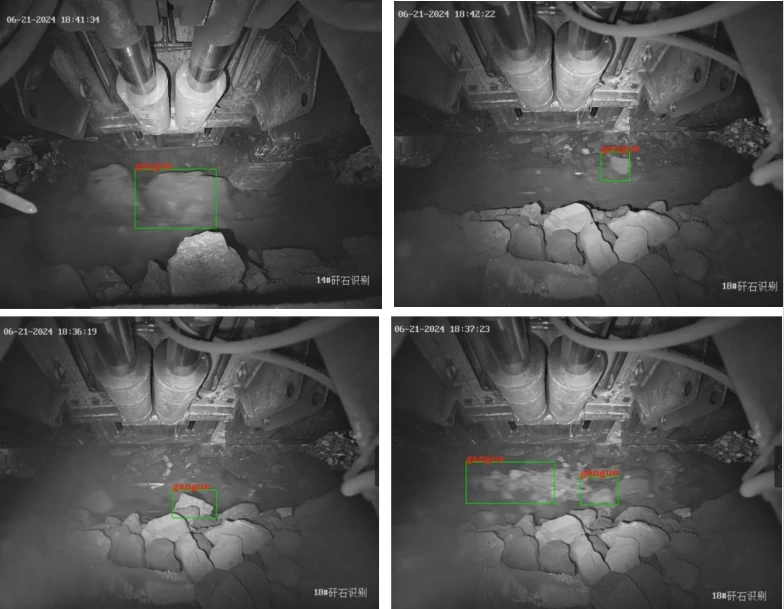
(AI automated recognition of Coal rocks (gangue) and distinguish with real coal mine)
2.2 Pros and Cons of Wide-Spectrum Cameras
Pros:
- Comprehensive Imaging: Wide-spectrum cameras provide a more complete picture of the environment by capturing images across multiple wavelengths.
- Versatility: They can be used in a wide range of applications, from hazard detection to equipment inspection.
- Improved Safety: Enhanced visibility and hazard detection capabilities contribute to a safer working environment.
Cons:
- Complexity: Wide-spectrum cameras are more complex to operate and interpret compared to standard cameras.
- Cost: These cameras can be expensive, particularly those with advanced features.
- Data Overload: The large amount of data generated by wide-spectrum cameras can be challenging to process and analyze.
3. Comparison of Thermal Imagers and Wide-Spectrum Cameras
While both thermal imagers and wide-spectrum cameras are valuable tools in coal mining, they serve different purposes and have distinct advantages and limitations.
Thermal Imagers are best suited for applications that require temperature monitoring, such as fire detection and equipment monitoring. They excel in environments where temperature differences are critical indicators of potential hazards.
Wide-Spectrum Cameras are more versatile and can be used in a broader range of applications, including low-light visibility, hazard detection, and environmental monitoring. They provide a more comprehensive view of the mining environment but may require more sophisticated analysis. It can be used as a replacement ordinary or low-light daylight camera, which is widely deployed under the mine.
4. Integration of Thermal Imagers and Wide-Spectrum Cameras in Mining Operations
To maximize the benefits of these technologies, many mining operations are integrating thermal imagers and wide-spectrum cameras into their safety and monitoring systems. For example:
- Real-Time Monitoring Systems: Combining thermal imagers and wide-spectrum cameras with real-time monitoring systems allows for continuous surveillance of the mining environment. This enables quick response to potential hazards.
- Automated Alerts: These systems can be configured to send automated alerts when anomalies are detected, such as a sudden increase in temperature or the presence of hazardous gases.
- Data Analytics: Advanced data analytics can be used to process the information collected by thermal imagers and wide-spectrum cameras, providing actionable insights for improving safety and efficiency.

(A comparison of one anti-explosive camera with Thermal vision + wide-spectrum fusion camera, the coalface)
5. Challenges and Future Directions
Despite their many advantages, the adoption of thermal imagers and wide-spectrum cameras in coal mining is not without challenges. These include:
- Cost: The high cost of these technologies can be a barrier to adoption, particularly for smaller mining operations.
- Training: Operators and engineers need specialized training to effectively use and interpret the data from these devices.
- Environmental Factors: Dust, humidity, and other environmental factors can affect the performance of thermal imagers and wide-spectrum cameras.
Looking ahead, advancements in technology are expected to address some of these challenges. For example, the development of more affordable and user-friendly devices, as well as improvements in data processing and analytics, will likely increase the adoption of these technologies in the mining
industry.
6. Conclusion
Thermal imagers and wide-spectrum cameras are powerful tools that have revolutionized safety and efficiency in coal mining. Their ability to detect hazards, monitor equipment, and provide enhanced visibility in challenging environments makes them indispensable for modern mining operations. While there are challenges to their adoption, the benefits they offer far outweigh the drawbacks. As technology continues to evolve, these devices will play an increasingly important role in ensuring the safety and productivity of coal mining operations.
By integrating thermal imagers and wide-spectrum cameras into their operations, mining companies can not only enhance safety but also improve operational efficiency, reduce downtime, and ultimately, increase profitability. As the mining industry continues to embrace digital transformation, these technologies will remain at the forefront of innovation.
Related products
- Uncooled Thermal imaging modules
- Wide-spectrum cameras
- Dual spectrum bullet camera
- Dual spectrum (fusion) camera (To be released)