


Abstract
The proliferation of unmanned aerial vehicles (UAVs) demands robust countermeasures to secure critical airspace. This article overviews established C-UAV methods, their strengths, and limitations. It then examines emerging UAV technologies-such as laser-guided first-person view (FPV) drones and autonomous AI-guided systems-and their challenges to current defenses. The core focus (75% of content) is a novel hierarchical solution that integrates layered detection, identification, and non-destructive neutralization via laser blinding of drone optics. This approach escalates responses proportionally, minimizing collateral while addressing modern threats effectively.
Introduction
UAVs have transformed applications from logistics to military operations, but their potential misuse poses escalating risks. The C-UAV market, projected to exceed $5 billion by 2028, emphasizes hierarchical defense-a layered escalation from passive monitoring to targeted intervention. This allows graduated responses, optimizing safety and efficiency.
Traditional technologies provide foundational capabilities but often overlook hierarchy, leading to disproportionate actions. Emerging UAV advancements further complicate defenses, necessitating innovative solutions. This essay dedicates 25% to established methods and emerging challenges, with 75% exploring a hierarchical system that culminates in laser blinding for optic disruption, highlighting its structured escalation for superior threat management.
Established C-UAV Technologies: Foundations and Limitations
C-UAV systems form a kill chain: detect, identify, track, engage. While effective, they frequently bypass hierarchy for direct neutralization.
- High-power laser (HPL) systems deliver energy to destroy components at range, offering low-cost, silent strikes. However, weather interference and debris limit urban use.
- High-power microwave (HPMW) weapons disrupt electronics across areas, ideal for swarms, but risk allied interference and demand high power.
- Kinetic weapon stations (CIWS adaption) use projectiles for interception, ensuring lethality, but ammunition constraints and collateral effects hinder hierarchy.
- RF detection and jamming, Spoofing identify then sever links, cost-effective for early layers, but fail against autonomous threats. Spoofing redirects via false signals, non-destructive for intelligence, yet ineffective on encrypted navigation.
- Other physical engagement.
These methods excel in high-threat scenarios but lack nuanced escalation, prompting needs for hierarchical innovations.
Emerging UAV Technologies and Their Challenges to C-UAV Measures
Advancements in UAVs amplify defense challenges, evading traditional hierarchies.
- Laser/Fiber-guided FPV drones, evolving from recreational to military use, employ laser designation for precision strikes. Seen in conflicts, they enable real-time operator control via video feeds, challenging detection due to low signatures and jamming resistance. Fiber-optic variants replace RF with cables, rendering RF jamming/spoofing obsolete and complicating radar tracking, as they emit minimal signals.
- Autonomous AI-guided UAVs leverage map matching, inertial navigation, vision-based systems, and AI for GPS-denied operations. Techniques like simultaneous localization and mapping (SLAM) allow real-time environment adaptation, bypassing RF vulnerabilities. Challenges include evading detection in cluttered areas, resisting spoofing through multi-sensor fusion, and sustaining swarms that overwhelm hierarchical responses. These demand advanced C-UAV with AI-driven prediction and non-RF effectors.
Such evolutions underscore the need for hierarchical systems that layer beyond RF, incorporating optic-targeted interventions.
The Novel Hierarchical C-UAV Solution: Laser Blinding for Non-Destructive Optic Disruption
Hierarchical Framework and Core Objectives
This hierarchical C-UAV system uses a layered, proportional defense to secure airspace against unauthorized drones. It escalates from passive radar/RF detection (>5 km range) and graded alerting, through directional jamming, to EO/IR confirmation with AI classification, and ends with laser blinding that overwhelms drone optical sensors (CMOS/FPA) - far more vulnerable than structural components - at up to 1 km.
Key advantages over traditional high-power laser (HPL) hard-kill: Requires much lower power and shorter dwell time (no sustained high-energy burn on one spot needed). A much lower power laser emitter (40-60W, < 100W) * with larger beam spot (0,3-0,5m) is sufficient to saturate and disable vision systems quickly, avoiding debris, collateral damage, and weather limitations of destructive HPL approaches. This makes it reversible, eco-friendly, and ideal for urban/sensitive environments.
The proposed system embodies a true hierarchical defense philosophy, deliberately structured to escalate responses in a controlled, proportional manner. This avoids the all-too-common "jump to destruction" seen in many traditional C-UAV setups, which often default to hard-kill regardless of threat level. The core objectives are:
- Enforce strict no-fly zones around protected areas (critical infrastructure, military bases, shipyards, urban nodes) while allowing graduated handling of accidental or low-threat incursions.
- Provide continuous 24/7, all-weather monitoring with early, long-range detection.
- Deliver precise identification and tiered alerting to enable informed decision-making.
- Achieve effective neutralization with maximum emphasis on non-destructive, low-collateral methods, reserving destructive options only for extreme cases.
Detailed System Design Explanation
Modularity and tight integration enable seamless escalation.
- Outer Layer (Detection): Wide-area 2D active phased-array radar scans continuously for small RCS targets (≤0.01 m²) at ranges >5 km, providing azimuth, elevation, distance, and velocity. Passive RF spectrum detection complements this by capturing control/video links without emitting signals - stealthy, eco-friendly, and effective against conventional RF drones. Together they deliver early, multi-target tracking (>200 simultaneous tracks) with high accuracy (<5 m position, <0.4° angular).
- Identification & Alerting Layer: A comprehensive drone feature database combined with advanced algorithms analyzes signal signatures, size, flight patterns, and behavior to distinguish UAVs from birds, balloons, or manned aircraft. Alerts are explicitly graded: a). Low-level (peripheral/warning zone): gentle notification (voice, light, soft warning broadcast) for likely accidental consumer drones, b). High-level (core no-fly zone): immediate full alarm, pre-planned activation, and escalation to next layer.
- Mid-Layer Active Countermeasure: Directional RF jamming selectively floods key control/image/GPS frequencies (430 MHz–5.8 GHz), with adjustable power and beamforming to minimize collateral interference. The system forces most conventional drones to hover, land, return-to-home, or lose control within seconds.
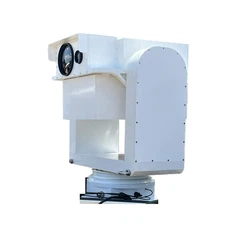
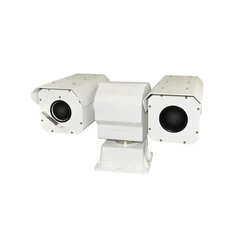
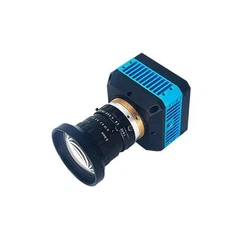
- Confirmation Layer: High-stability gimbaled EO/IR turret auto-slews to radar/RF cues. Dual-mode imaging (HD EO and 640 MWIR) ensures day/night, fog/rain performance. AI classifies drone type (multi-rotor, fixed-wing), assesses payload/behavior, and records full-motion video evidence. The gimbal delivers ≤0.x mrad stabilization (active during pan/tilt and tracking), ≤0.x mrad closed-loop accuracy, continuous azimuth, -xx°~ + xx° elevation, and user-definable presets with custom bore-sight reticles for offset tracking. Automatic small-area sector scans in designated zones enhance proactive search.
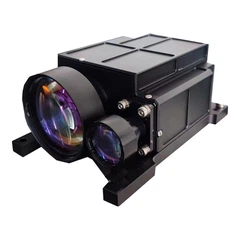
- Endpoint Layer – Laser Blinding: When all prior layers fail and the threat reaches the core zone (typically ≤1 km), high-precision servo turrets direct low-to-medium power lasers to saturate the drone's optical sensors (CMOS/FPA arrays). These sensors are orders of magnitude more vulnerable than structural components - they saturate and become unusable with far less energy than required to burn through a fuselage or propeller.
Key engineering advantage: blinding does not require sustained, ultra-high-power focus on a single structural point (as traditional HPL hard-kill does). A larger beam spot (not pinpoint burn) is sufficient to overwhelm the entire sensor array quickly (sub-second to few-second dwell), causing mission failure (loss of visual navigation, targeting, or reconnaissance) without physical destruction. This drastically reduces:
- Required power (fraction of HPL hard-kill levels)
- Dwell time
- Pointing precision demands
- Weather sensitivity
- Debris/explosion risk
The result: reversible, non-lethal, zero-collateral disablement - ideal for urban, industrial, or populated areas where hard-kill fallout is unacceptable.
System Features: Benefits of Hierarchical Design
The hierarchical philosophy delivers transformative advantages:
- Proportional Escalation - Graduated responses match actual risk, avoiding unnecessary hard-kill and reducing false-positive aggression.
- Ultra-Low Collateral Soft-Kill - Laser blinding saturates vulnerable CMOS/FPA optics with modest power and short dwell - no need for high-energy, long-duration structural burn like traditional HPL. Larger spot size suffices, eliminating debris, explosion, and collateral concerns.
- Resilience Against Emerging Threats - Remains highly effective versus autonomous AI-guided UAVs (SLAM/map-matching/vision fusion) and laser/fiber-optic FPV drones (immune to RF jamming/spoofing) by targeting vision directly - the last remaining critical dependency for most UAV missions.
- All-Weather, 24/7 Autonomy - MWIR excels in humid/tropical urban clutter; gimbal stabilization (≤0.1 mrad) ensures steady tracking; IP67 sensors and -10°C to +55°C range support harsh conditions.
- Cost & Sustainability - Fraction of HPL/HPM power, unlimited shots, zero spectrum pollution, no debris - sustainable for prolonged operations.
- Scalability & Future-Proof - Networked multi-station coverage (10–20+ km radii), modular gimbals (HD-SDI, customizable presets), AI sector scanning, and open architecture support swarm defense and future upgrades.
Effectiveness and Hierarchical Visualization
Coverage ensures escalation without gaps: outer zones warn, inner neutralize precisely. Scaled deployments maintain layered security.
The EO/IR gimbal's 30% design margin for 0.3-0.2 m drone recognition at >1 – 1.2 km, combined with clutter rejection, bolsters mid-to-inner layers against urban challenges.
Conclusion
Hierarchical defense is pivotal in C-UAV evolution. While established methods lay groundwork, emerging UAVs demand layered innovation. The laser blinding system, through structured escalation, offers precise, low-impact protection, addressing modern challenges effectively.
Remark:
*High-power lasers (>1.5kW output) are now explicitly subject to strict dual-use export licensing requirements by MOFCOM. These fall under controlled categories for equipment, components, and systems that could support military applications, directed energy weapons (DEW), or high-energy laser (HEL) burning/destruction modes.