

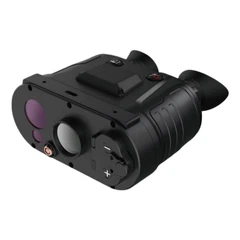

The Paul prism is the most commonly used optical part in hand-held binoculars. Through it, the inverted image formed by the objective lens can be turned upside down again into a positive image. The structure of the Paul prism itself is very simple, and the cross section is an isosceles right triangle. The three included angles are 45°, 45° and 90°, so the manufacturing difficulty is very low. In addition, the Paul prism uses the principle of total reflection to reflect the incident light, and does not need to be coated with a reflective film, and a set of Paul prisms only need to be placed on the oblique The two sides where the edge is located are coated with anti-reflection coating, so the cost of the Paul prism is relatively low! And there is no double aberration and phase difference in the Paul prism, so the telescope using the Paul prism can often obtain good optical effects, and the price is relatively low. However, Paul's incident light and outgoing light are not on the same line. This structure leads to a relatively large volume and weight of the telescope, and the distance between the center of the objective lens is too large, resulting in a strong three-dimensional effect of the telescope, which is not suitable for observing close distances within a few meters. Target. At present, Paul prisms are mainly used in low-end hand-held telescopes, large-aperture telescopes, and special military telescopes. For low-end products, better optical effects can be achieved at a very low price. For large-aperture telescopes, there is no portability in itself. It doesn't matter at all to use Paul prisms, and the cost is lower and the effect is better. For military telescopes only, Paul prisms can be used to obtain a stronger structure. Judging from the development trend of the market, the mainstream hand-held telescopes will be roof prisms, and Paul prisms have been marginalized in fact!
Binoculars - Paul Prism
Jan 19, 2023
Leave a message