

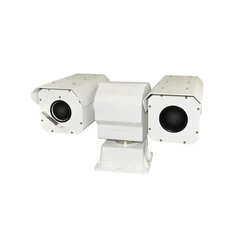
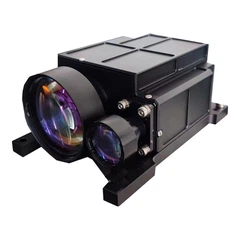
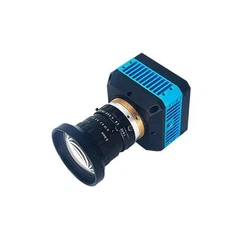

Short-wave infrared refers to the wavelength range between 1.4 and 3 microns in the infrared spectrum. It is between visible light and mid-wave infrared. It is invisible to the human eye and is a very important spectral region. Indium gallium arsenide sensor is currently the main sensor used in short-wave infrared imaging, with an operating band range of 900-1700 nanometers.
First of all, SWIR has very good transmittance. Its wavelength is much shorter than MWIR, so the phase is less disturbed, has strong depth penetration ability, and can be accurately transmitted to the imaging system. At the same time, SWIR has a lower refractive index than visible light, so it can "see through" non-uniform materials and obtain high-definition imaging in high-energy situations such as flares.
Secondly, SWIR has very good resolution. In modern imaging technology, SWIR imaging system can achieve micron-level accurate imaging, which is more detailed than MWIR. This sensitivity can be directly used in applications such as distinguishing surface materials, identifying chemical species, and detecting hidden defects and weaknesses.
In addition, SWIR can also more accurately detect and study the performance and characteristics of microstructures and chemical reactions. In addition, SWIR has good environmental adaptability. Since MWIR sensors cannot penetrate dry impurities such as fog, suspended particles, and organic substances, SWIR is a spectrum that is relatively less sensitive to impurities. In the natural atmospheric environment, , SWIR can perform more stably than other infrared segments and can obtain more realistic images and data.
Finally, SWIR also has its unique photophysical properties, such as pyroelectric effect, optical debleaching effect, optical distortion, etc. These properties play a key role in modulating and controlling higher precision requirements in lumen and brightness. In addition, SWIR can also better identify objects with sharpness and strong reflectivity, providing higher safety and accuracy in imaging and identification.
What Is The Difference Between SWlR And MWIR
May 02, 2024
Leave a message