

When it comes to infrared (IR) optical systems, IR optical prisms play a crucial role. As an IR Optics supplier, I've been in the trenches, dealing with these prisms day in and day out. So, I thought it'd be cool to share some insights on the performance indicators of IR optical prisms.
First off, let's talk about transmittance. Transmittance is basically how much of the incident IR light can pass through the prism. In an ideal world, we'd want 100% of the light to make it through. But in reality, there are always some losses due to absorption, reflection, and scattering. Good-quality IR optical prisms have high transmittance in the desired IR wavelength range. For example, if you're working in the long-wave infrared (LWIR) region, you'd want a prism that has high transmittance around 8 - 14 micrometers. This is super important because if the transmittance is low, a significant amount of the IR light won't reach the detector, which can lead to poor image quality or inaccurate measurements.
Next up is the refractive index. The refractive index of a prism determines how much the light bends when it enters and exits the prism. Different materials have different refractive indices, and this property is used to manipulate the path of the IR light. A stable and well - defined refractive index is essential. Any variations in the refractive index can cause aberrations in the optical system. For instance, if the refractive index changes with temperature (which is common), it can lead to a phenomenon called thermal lensing, where the focus of the optical system shifts as the temperature changes. That's why we often look for materials with a low temperature coefficient of refractive index to minimize these effects.
Dispersion is another key performance indicator. Dispersion refers to how the refractive index of the prism material varies with the wavelength of the light. In IR optics, different wavelengths carry different types of information. For example, in a multispectral IR imaging system, you might want to separate different IR bands. A prism with the right dispersion characteristics can be used to achieve this. However, dispersion can also be a problem if not managed properly. It can cause chromatic aberration, where different wavelengths of light focus at different points, leading to blurry images.
Then there's surface quality. The surface of an IR optical prism needs to be extremely smooth and free of defects. Even tiny scratches or roughness on the surface can cause scattering of the IR light. Scattering not only reduces the overall transmittance but also introduces noise into the optical system. High - precision manufacturing processes are used to ensure that the prism's surfaces are of the highest quality. This involves processes like grinding, polishing, and coating. The coatings on the prism surface can also enhance its performance. For example, anti - reflective coatings can reduce the reflection losses and increase the transmittance.
Another important factor is the angular accuracy. IR optical prisms are often used to deviate or rotate the path of the IR light by a specific angle. The accuracy of this angle is crucial for the proper functioning of the optical system. Even a small deviation from the desired angle can cause problems in image alignment or measurement accuracy. Manufacturing techniques need to be highly precise to achieve the required angular accuracy. Specialized metrology equipment is used to measure and verify the angles of the prisms during the manufacturing process.
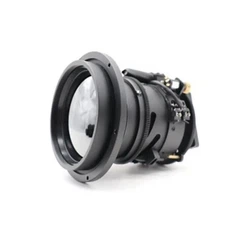
Now, let's tie this into some of the products we offer. We've got some great lenses like the Athermalized LWIR Lens. This lens is designed to work well in the LWIR region, and the performance of the prisms used in it is optimized for this wavelength range. The prisms in this lens have high transmittance, stable refractive index, and carefully managed dispersion to ensure clear and accurate imaging.
Our 45 - 900mm MWIR F4.0 lens is another example. It operates in the mid - wave infrared (MWIR) region, and the prisms are engineered to handle the specific requirements of this wavelength range. The surface quality of the prisms in this lens is top - notch to minimize scattering and ensure high - quality images.
And then there's the Motorized Focusing LWIR Lens. This lens uses prisms with excellent angular accuracy to ensure that the light is properly directed through the optical system, even when the focus is being adjusted. The stability of the refractive index of the prisms is also important in this case to maintain focusing precision.


If you're in the market for IR optical prisms or any related IR optical products, we'd love to have a chat. Whether you're working on a research project, building an industrial inspection system, or involved in any other application that requires high - quality IR optics, we've got the expertise and the products to meet your needs. Contact us to start a conversation about your requirements and let's work together to find the best solutions for you.
References
- Smith, J. (2018). Introduction to Infrared Optics. Optical Publishing.
- Johnson, A. (2020). Advanced Prism Design for Infrared Applications. Optics Journal.